Hook
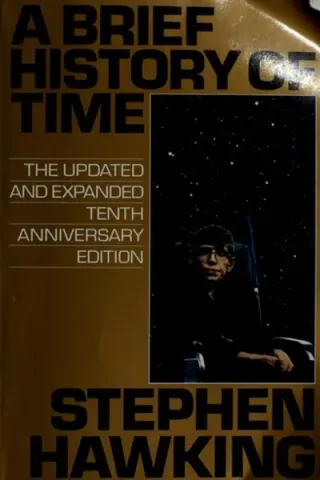
Stephen Hawking set out to write a book about black holes, the Big Bang, and time that anyone could understand. It remains the bestselling science book of all time — though not everyone who bought it finished it.
What It’s About
A Brief History of Time covers the biggest questions in physics for a general audience. Hawking traces understanding from Newton through Einstein’s relativity, quantum mechanics, and his own work on black hole radiation. He covers the expanding universe, the uncertainty principle, the arrow of time, wormholes, and the search for a unified theory.
The writing is clear and often witty, but genuinely difficult in places. The later chapters on quantum gravity challenge even scientifically literate readers.
Key Takeaways
Hawking’s most accessible point is that science builds and discards models — Newton’s physics worked until Einstein showed it was incomplete, which works until you get to the quantum level. The history of science is increasingly accurate approximations, not final truths.
The discussion of black holes — Hawking’s discovery that they emit radiation and eventually evaporate — is the book’s highlight and masterful popular science writing.
The Verdict
A Brief History of Time earns its classic status through ambition and clarity, even if it occasionally exceeds comprehension. Don’t worry about understanding every chapter — the early and middle sections provide a richer understanding of the universe than most people achieve in a lifetime.