Hook
Computer science has spent decades solving problems that humans face every day — when to stop searching, how to sort priorities, when to explore versus exploit. The solutions are mathematically optimal, and they apply to your life far more directly than you’d expect.
What It’s About
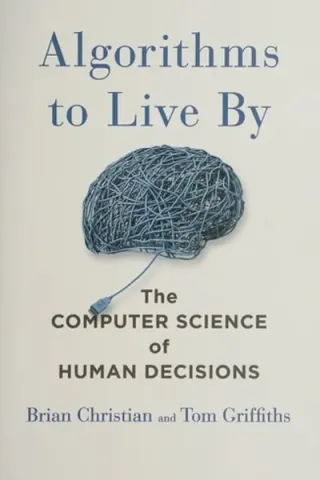
Algorithms to Live By takes concepts from computer science — optimal stopping, explore/exploit tradeoffs, sorting, caching, scheduling, Bayesian reasoning — and applies them to everyday human decisions. When should you stop looking at apartments and commit? (After seeing 37% of your options.) How should you organize your closet? (Most recently used items in front.) When should you try a new restaurant versus returning to a favorite? (Explore more when you have more time ahead of you.)
Christian and Griffiths write with exceptional clarity, making complex algorithms accessible without dumbing them down. Each chapter takes a computer science concept, explains how it works, tells the story of its discovery, and then shows how it applies to human decision-making. The connections are often surprising and always illuminating — you’ll never think about apartment hunting, filing systems, or scheduling the same way again.
The book’s greatest achievement is showing that many of our most frustrating problems — the anxiety of making decisions, the chaos of disorganized information, the stress of overscheduling — have been formally studied and, in many cases, solved. The solutions don’t always tell you what to do, but they often tell you when to stop worrying about what to do.
Key Takeaways
The “optimal stopping” problem (also called the secretary problem or the 37% rule) is the book’s most immediately practical concept. When you must make an irreversible decision from a sequence of options — hiring a candidate, choosing an apartment, picking a partner — mathematics says you should spend the first 37% of your time exploring without committing, then commit to the next option that’s better than everything you’ve seen so far.
The explore/exploit tradeoff is equally useful. When you have more time ahead (you’re young, you’re new to a city), you should explore more — try new things even if they might be worse than known options. When you have less time remaining, exploit what you know works. This mathematical framework transforms life-stage decisions from existential crises into optimization problems.
The Verdict
Algorithms to Live By is one of the most original and practical popular science books in years. It transforms abstract computer science into immediately applicable life wisdom, and it does so with humor, clarity, and intellectual depth. Essential reading for anyone who makes decisions — which is, of course, everyone.