Hook
History is not a gentle slope — it’s a series of explosions. Nassim Taleb argues that rare, unpredictable events shape the world far more than trends and forecasts, and that our entire intellectual framework is built to ignore them.
What It’s About
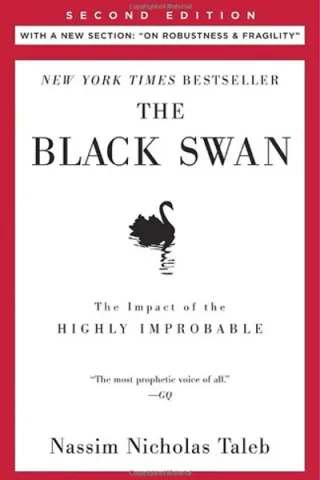
The Black Swan is about the outsized impact of rare, unpredictable, high-consequence events — what Taleb calls “Black Swans.” The name comes from the European assumption that all swans were white, an assumption that survived millions of observations but was destroyed by a single sighting of a black swan in Australia. Taleb argues that our world is dominated by similar events: 9/11, the internet, World War I, the 2008 financial crisis.
Taleb’s central critique targets the human tendency to construct explanatory narratives after rare events occur, creating the illusion that they were predictable. He calls this the “narrative fallacy” — our compulsion to turn random events into coherent stories. Coupled with “confirmation bias” (seeking evidence that supports existing beliefs) and “the ludic fallacy” (applying simplified models to complex reality), these cognitive errors make us systematically blind to Black Swans.
The book is intellectually ambitious, drawing on probability theory, philosophy, cognitive science, and Taleb’s experience as an options trader. It’s also deliberately provocative — Taleb attacks Nobel Prize-winning economists, business school professors, and anyone he considers guilty of false precision. The writing is stimulating but self-indulgent, and Taleb’s contempt for his intellectual opponents can be exhausting.
Key Takeaways
The most practically useful idea is “barbell strategy” thinking — instead of trying to predict the future (which you can’t), structure your life and investments to limit downside risk while maintaining exposure to positive Black Swans. In investing, this means putting 90% in ultra-safe assets and 10% in speculative bets with unlimited upside.
Taleb’s critique of forecasting is also important. He provides compelling evidence that expert predictions — in economics, politics, and technology — are barely better than random chance, yet we continue to treat them as authoritative. The appropriate response to uncertainty isn’t better prediction models; it’s building robustness and optionality.
The Verdict
The Black Swan contains genuinely important ideas about uncertainty, risk, and the limits of human knowledge. The problem is Taleb himself — his arrogance and repetitiveness make the book harder to read than it needs to be. Push through the personality and you’ll find insights that will permanently change how you think about risk and prediction.