Hook
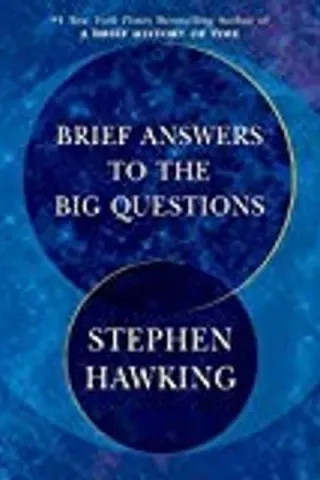
Stephen Hawking’s final book tackles the ten biggest questions he was asked throughout his career — from “Is there a God?” to “Will artificial intelligence outsmart us?” — with his trademark clarity, humor, and intellectual fearlessness.
What It’s About
Brief Answers to the Big Questions is a posthumous collection of Hawking’s writings and speeches on the questions he was most frequently asked. Published after his death in 2018, the book addresses ten questions: Is there a God? How did it all begin? Is there other intelligent life in the universe? Can we predict the future? What is inside a black hole? Is time travel possible? Will we survive on Earth? Should we colonize space? Will artificial intelligence outsmart us? How do we shape the future?
Hawking addresses each question with the accessible brilliance that made A Brief History of Time a phenomenon. He brings physics to bear on questions that might seem philosophical — arguing, for example, that the laws of physics themselves explain the universe’s existence without requiring a creator, and that time travel to the future is not only possible but routinely demonstrated by GPS satellites.
The book is more personal and opinionated than his earlier work. Hawking shares his views on climate change, nuclear war, genetic engineering, and the future of humanity with urgency and conviction. The writing is clearer and more conversational than A Brief History of Time, making this the most accessible of Hawking’s books.
Key Takeaways
Hawking’s argument that science and curiosity are humanity’s best tools for survival is the book’s unifying theme. He argues that the greatest risks to human civilization — nuclear war, climate change, engineered pandemics, rogue AI — can only be mitigated through scientific understanding and international cooperation. His optimism about humanity’s potential is tempered by a clear-eyed assessment of the risks.
The chapter on artificial intelligence is particularly prescient. Hawking was among the first prominent scientists to warn that AI could pose an existential risk, not because it would become malevolent but because a superintelligent system pursuing goals misaligned with human values could be catastrophic — like an ant colony in the path of a highway construction project.
The Verdict
Brief Answers to the Big Questions is a fitting final work from one of the greatest scientific minds of our era. It’s more accessible than A Brief History of Time and more personal than The Grand Design. Not every answer is fully satisfying — some questions really are too big for a single chapter — but Hawking’s intellectual courage and clarity make every page worth reading.