Hook
The conversations that matter most — where stakes are high, opinions vary, and emotions run strong — are exactly the ones we handle worst. This book provides a framework for navigating them without destroying relationships.
What It’s About
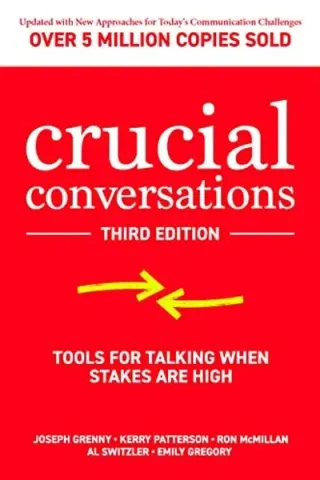
Crucial Conversations defines a “crucial conversation” as any discussion where stakes are high, opinions differ, and emotions are strong. These are the moments that disproportionately determine the quality of your relationships, your career, and your health — and most people either avoid them entirely or handle them so badly that things get worse.
The authors, a team of organizational behavior researchers, present a model for staying in dialogue when instincts push you toward silence (withdrawing) or violence (attacking). The core framework centers on creating a shared “pool of meaning” — ensuring that all relevant information, opinions, and feelings get into the conversation, even when they’re uncomfortable.
Key tools include “Start with Heart” (clarifying what you really want before speaking), “Learn to Look” (recognizing when a conversation becomes crucial), “Make It Safe” (restoring safety when someone feels threatened), and “STATE My Path” (sharing your views persuasively without shutting down others). The book is rich with dialogue examples that show exactly how these tools work in practice — from confronting an underperforming employee to discussing infidelity with a spouse.
Key Takeaways
The insight that most crucial conversations fail because of safety, not content, is the book’s most important contribution. When people feel unsafe — when they believe they’ll be punished, embarrassed, or rejected for speaking honestly — they either clam up or blow up. The primary job in any crucial conversation is to make it safe for everyone to share their meaning, even when the topics are explosive.
The “STATE” framework for sharing sensitive opinions is immediately useful: Share your facts, Tell your story, Ask for their path, Talk tentatively, and Encourage testing. This structure allows you to raise difficult issues without triggering defensiveness, by leading with observable facts rather than conclusions, accusations, or ultimatums.
The Verdict
Crucial Conversations is one of the most practically useful communication books ever written. The frameworks work in professional and personal contexts, the examples are realistic, and the skills are learnable. If you struggle with conflict — whether you avoid it or escalate it — this book provides tools that will materially improve your relationships.