Hook
Mark Manson’s follow-up to The Subtle Art asks a darker question: in a world that’s safer and more prosperous than ever, why is everyone so anxious, angry, and hopeless? The answer involves Kant, Newton, and a lot of uncomfortable truths about hope.
What It’s About
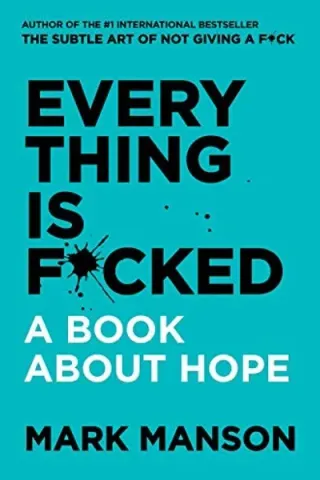
Everything is F*cked is a book about hope — specifically, why we’re losing it and whether that’s actually a problem. Manson argues that human beings require hope to function, and that hope is constructed from three elements: a sense of control, a belief in our own values, and a community to belong to. When any of these pillars collapses, despair follows.
The book traces the “crisis of hope” through philosophy, neuroscience, and cultural criticism. Manson draws on Immanuel Kant’s moral philosophy, the psychology of emotional reasoning, and the perverse effects of technological progress to argue that modernity has undermined the traditional sources of hope (religion, community, shared struggle) without replacing them with anything equally compelling.
The writing is characteristically irreverent, peppered with profanity and dark humor. But this is a more ambitious and less accessible book than The Subtle Art. Manson ventures into philosophical territory that occasionally exceeds his grasp, and the later chapters on AI and the future of humanity feel speculative rather than grounded. The first half, focused on the psychology of hope and the nature of human motivation, is considerably stronger.
Key Takeaways
Manson’s “Feeling Brain vs. Thinking Brain” framework is a useful simplification of dual-process theory. He argues that the Feeling Brain drives most of our decisions and that the Thinking Brain’s role is primarily to rationalize what the Feeling Brain has already decided. This isn’t new in psychology, but Manson’s accessible presentation makes it click for readers unfamiliar with Kahneman’s work.
The chapter on “Newton’s Laws of Emotion” — the idea that every action creates an equal and opposite emotional reaction, and that our emotional energy is conserved rather than created or destroyed — is provocative. Manson argues that a life without pain isn’t a happy life; it’s a meaningless one, because meaning requires struggle.
The Verdict
Everything is F*cked is an uneven book with genuinely brilliant passages and sections that feel overambitious. It’s worth reading for the first half alone, which offers Manson’s most thoughtful writing on meaning, motivation, and emotional reasoning. But it doesn’t match the focused clarity of The Subtle Art, and some readers will find the philosophical detours more frustrating than illuminating.