Hook
Intel’s legendary CEO wrote the management playbook that Silicon Valley still runs on four decades later. Andrew Grove treats management not as an art or a philosophy but as a production process — one that can be measured, optimized, and scaled.
What It’s About
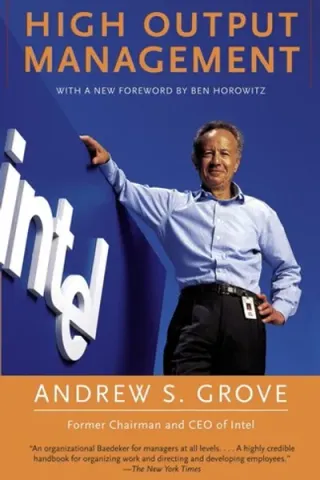
High Output Management is a practical management guide from Andrew Grove, who built Intel into one of the most valuable companies in the world. Grove approaches management as a manufacturing process: a manager’s output is the output of their organization, and the manager’s job is to maximize that output through leverage.
The book covers meeting management, decision-making, performance reviews, compensation, organizational structure, and the role of middle managers. Grove introduces the concept of “managerial leverage” — the idea that some activities produce far more output per unit of managerial time than others. A one-on-one meeting that prevents an employee from quitting has enormous leverage; attending a meeting where your input isn’t needed has none.
The writing is direct, no-nonsense, and packed with specific frameworks. Grove uses manufacturing analogies (breakfast factories, quality control, process optimization) to make abstract management concepts concrete. The book is particularly strong on one-on-one meetings, which Grove considers the most important tool in a manager’s arsenal.
Key Takeaways
Grove’s framework for one-on-ones is the book’s most widely adopted contribution. He argues that one-on-ones are the employee’s meeting, not the manager’s — the agenda should come from the direct report, and the manager’s role is to listen, coach, and remove obstacles. This simple shift transforms one-on-ones from status updates into development conversations.
The concept of “task-relevant maturity” — adjusting your management style based on an employee’s experience with a specific task, not their overall seniority — is nuanced and practical. A veteran employee taking on an unfamiliar project needs more guidance than they would for their area of expertise. Management style should match the situation, not the person.
The Verdict
High Output Management is the most practical and least pretentious management book ever written. It treats management as a craft to be learned and optimized, not a mystical art requiring innate talent. Required reading for anyone who manages people, especially in technology companies.