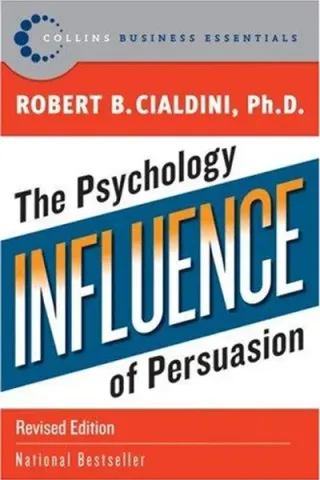
Hook
Why did you buy that thing you didn’t need? Why did you say yes when you meant no? Robert Cialdini spent years studying compliance professionals and found six universal triggers that override rational thinking.
What It’s About
Influence is a landmark work in social psychology that identifies six principles of persuasion: reciprocity, commitment and consistency, social proof, authority, liking, and scarcity. Cialdini argues that these principles are hardwired into human psychology and exploited by anyone trying to get you to comply.
Each principle gets its own chapter, packed with research studies and real-world examples. Cialdini went through sales training programs, observed car dealerships, and infiltrated organizations to study persuasion in practice. The reciprocity chapter alone will change how you think about free samples forever.
What makes the book endure is that Cialdini doesn’t just describe the principles — he explains why they exist evolutionarily and how to defend yourself against them. The framework is immediately applicable whether you’re in marketing, negotiation, or just trying to avoid being manipulated.
Key Takeaways
The most practically useful principle is reciprocity — the deeply ingrained human tendency to repay favors. Cialdini shows how this is weaponized through unsolicited gifts, free trials, and the “rejection-then-retreat” technique.
Social proof — our tendency to look to others when uncertain — is equally powerful. Cialdini demonstrates that people decide what’s correct by observing what others are doing, which explains phenomena from bestseller lists to tip jars pre-loaded with cash.
The Verdict
Influence is one of those rare books that genuinely changes how you see the world. It’s essential reading for marketers, negotiators, and anyone who wants to understand why they make the decisions they do. The principles are as relevant today as they were in 1984.