Hook
Why do some ideas survive and others die? The Heath brothers spent years studying “sticky” ideas and discovered six principles that make the difference between an idea that changes behavior and one that’s forgotten by lunch.
What It’s About
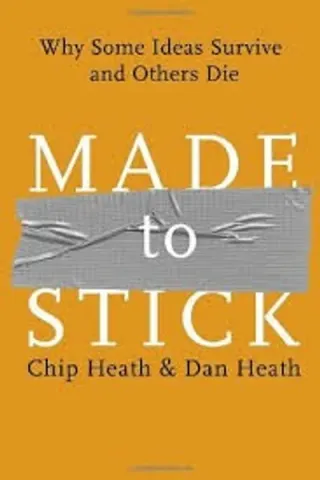
Made to Stick investigates why certain ideas — urban legends, proverbs, conspiracy theories — embed themselves in memory while others, often more important, vanish immediately. The Heath brothers identify six principles that make ideas stick, captured in the acronym SUCCESs: Simple, Unexpected, Concrete, Credible, Emotional, and Stories.
Each principle gets its own chapter with rich examples. Simplicity means finding the core of the idea (not dumbing it down). Unexpectedness means breaking a pattern to get attention. Concreteness means using specific, sensory language rather than abstractions. Credibility means making the idea believable. Emotion means making people feel something. Stories means wrapping the idea in a narrative.
The writing is itself an example of the principles it teaches — clear, surprising, concrete, and packed with memorable stories. The book is particularly useful for anyone who needs to communicate ideas effectively: teachers, marketers, leaders, writers, and presenters.
Key Takeaways
The “Curse of Knowledge” — the cognitive bias that makes it hard to remember what it’s like not to know something — is the book’s most important concept. Once you know something, you can’t unknow it, which makes you terrible at communicating it to someone who doesn’t know it. This is the single biggest barrier to effective communication in organizations.
The power of concreteness is also actionable. Abstract strategies fail to motivate; concrete ones succeed. “Improve customer satisfaction” is abstract and forgettable. “Call every unhappy customer within 24 hours” is concrete and actionable. The Heaths show that concreteness is not the enemy of sophistication — it’s the vehicle for it.
The Verdict
Made to Stick is one of the most practical and useful communication books ever written. The SUCCESs framework is simple enough to remember, versatile enough to apply in any domain, and backed by enough research and examples to be genuinely convincing. Required reading for anyone who needs their ideas to survive contact with an audience.