Hook
A psychiatrist survives Auschwitz and emerges with one radical insight: the people who survived the camps weren’t the strongest or the smartest — they were the ones who found meaning in their suffering.
What It’s About
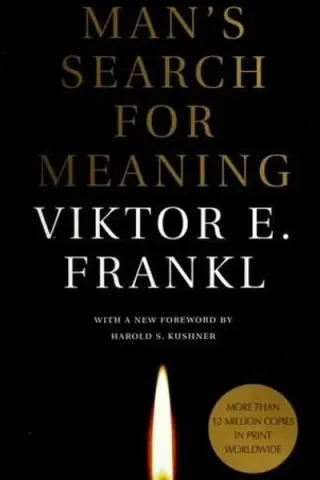
Man’s Search for Meaning is divided into two parts. The first is Frankl’s harrowing but remarkably measured account of his years in Nazi concentration camps. He doesn’t dwell on the horrors for shock value — instead, he observes the psychological responses of prisoners with a clinician’s eye. He notices that those who had something to live for — a loved one waiting, a manuscript to finish, a purpose beyond survival — were far more likely to endure.
The second part introduces logotherapy, Frankl’s school of psychotherapy built on the idea that the primary human drive is not pleasure (Freud) or power (Adler), but meaning. Frankl argues that meaning can be found in three ways: through work and creation, through love and relationships, and through suffering itself — by choosing one’s attitude in unavoidable pain.
What makes this book extraordinary is that it’s not theoretical. Frankl’s philosophy was forged in the worst conditions imaginable, which gives his ideas an authority that armchair philosophers can’t match. The writing is spare, dignified, and deeply humane. At under 200 pages, every sentence carries weight.
Key Takeaways
The central insight — “He who has a why to live can bear almost any how” (borrowed from Nietzsche) — is the backbone of the book. Frankl demonstrates that meaning isn’t something you find passively; it’s something you create through your choices, even in circumstances where every freedom has been stripped away. The last human freedom, he insists, is the freedom to choose your attitude.
Frankl also challenges the pursuit of happiness directly. He argues that happiness cannot be pursued — it must ensue as a side effect of dedicating yourself to something greater. This reframes the modern obsession with “finding happiness” as fundamentally misguided. Meaning first, happiness follows.
The Verdict
This is one of the most important books of the twentieth century, and it earns that distinction on every page. It’s short, profound, and life-altering in the truest sense. If you read one book on what it means to be human, make it this one.