Hook
Most of what we call “communication” is actually judgment, criticism, and demand disguised as conversation. Marshall Rosenberg developed a framework that strips away the violence in our language and replaces it with connection.
What It’s About
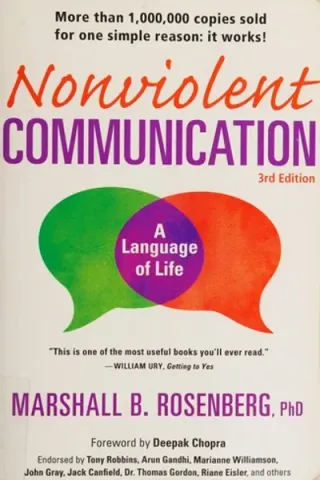
Nonviolent Communication (NVC) presents a four-step framework for expressing yourself honestly and hearing others empathically. Rosenberg, a clinical psychologist who worked in conflict zones around the world, observed that most communication breakdowns stem from the same pattern: confusing observations with evaluations, suppressing feelings, ignoring needs, and making demands instead of requests.
The NVC process has four components. First, observe without evaluating — describe what happened factually, without judgment (“You’ve been late three times this week” rather than “You’re irresponsible”). Second, identify and express your feelings (“I feel frustrated” rather than “I feel like you don’t care”). Third, connect feelings to underlying needs (“because I need reliability in our arrangement”). Fourth, make a clear, specific request (“Would you be willing to call me if you’re going to be late?”).
Rosenberg extends the framework to empathic listening — hearing what others are feeling and needing behind their words, even when those words are hostile or inarticulate. He demonstrates NVC in extraordinary contexts: mediating between warring groups in the Middle East, counseling gang members, and resolving marital conflicts on the brink of divorce. The framework is simple but the practice is challenging, requiring a fundamental shift from habitual patterns of blame and defense.
Key Takeaways
The distinction between observations and evaluations is NVC’s most immediately practical tool. Most conflict escalates because people present their judgments as facts. “You always interrupt me” is an evaluation that triggers defensiveness. “In our last three meetings, I noticed you spoke before I finished my sentence” is an observation that opens dialogue. This single shift can transform the quality of any difficult conversation.
Rosenberg’s insight that all human behavior is an attempt to meet universal needs — for connection, autonomy, meaning, safety, etc. — provides a powerful framework for empathy. When someone behaves badly, asking “What need are they trying to meet?” transforms your response from judgment to understanding, without requiring you to condone the behavior.
The Verdict
Nonviolent Communication is one of the most transformative communication books ever written. The framework is deceptively simple and genuinely difficult to practice, but even partial application produces dramatic improvements in relationships. Essential reading for anyone who wants to fight less, connect more, and communicate with integrity.