Hook
A small change in the way options are presented — moving the salad bar to the front of the cafeteria, changing the default on a retirement savings form — can have a bigger impact on behavior than any regulation, incentive, or education campaign. That’s the power of a nudge.
What It’s About
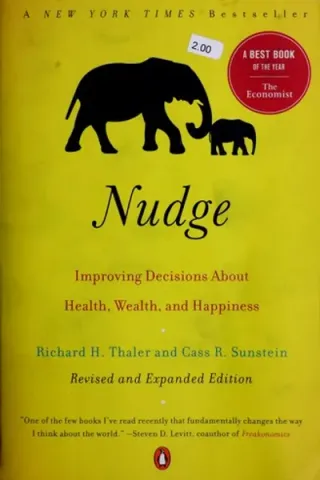
Nudge introduces the concept of “libertarian paternalism” — the idea that institutions can guide people toward better choices without restricting their freedom. Thaler (a Nobel Prize-winning behavioral economist) and Sunstein (a legal scholar) argue that since every choice is presented in some context, and that context inevitably influences decisions, we might as well design that context to help people rather than hinder them.
The book’s central concept is “choice architecture” — the design of environments in which people make decisions. Default options are the most powerful nudge: most people stick with whatever is pre-selected, whether it’s organ donation, retirement savings, or software settings. Other nudges include simplification (making desired behaviors easier), social norms (showing people what others are doing), and feedback (giving people information about the consequences of their choices in real time).
Thaler and Sunstein apply their framework to major policy areas: retirement savings (auto-enrollment dramatically increases participation), healthcare (simplifying plan choices helps people select better coverage), environmental policy (showing people how their energy use compares to neighbors reduces consumption), and organ donation (opt-out vs. opt-in dramatically changes donation rates).
Key Takeaways
The power of defaults is the book’s most important practical lesson. In almost every domain, the default option is the most commonly chosen option — not because it’s the best, but because changing it requires effort. This means that whoever sets the default wields enormous invisible power. Understanding this makes you both a better decision-maker (always question defaults) and a better designer of systems.
The concept of “status quo bias” — our deep preference for the current state of affairs — explains why nudges work. People aren’t making active choices to keep the default; they’re simply not making any choice at all. Nudges work by aligning the path of least resistance with the outcome that serves people best.
The Verdict
Nudge is an important book that influenced governments worldwide and introduced concepts now standard in behavioral science. The writing can be dry, and the policy chapters are less engaging than the psychological insights. But the core ideas about choice architecture are immediately applicable to anyone who designs forms, manages teams, builds products, or makes decisions.