Hook
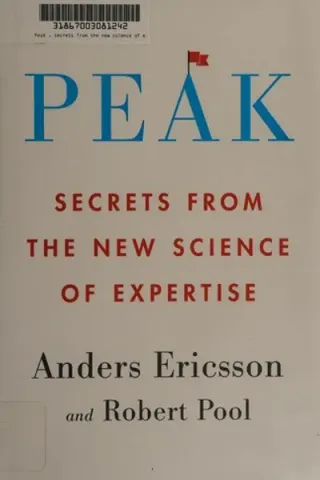
The “10,000-hour rule” made famous by Malcolm Gladwell was based on Anders Ericsson’s research — and Gladwell got it wrong. The scientist behind the science explains what deliberate practice actually requires.
What It’s About
Peak is the definitive account of deliberate practice from the researcher who originated the concept. Anders Ericsson, a professor of psychology at Florida State, spent decades studying expert performers across domains — musicians, chess players, athletes, doctors, mathematicians — to understand what separates the best from the rest. His answer is not talent, not experience, and not mere hours of practice. It’s deliberate practice — a specific, structured form of training with clear characteristics.
Deliberate practice involves working on specific weaknesses, getting immediate feedback, maintaining intense concentration, and operating just beyond your current ability level. It’s not fun — in fact, it’s consistently described as effortful and uncomfortable. But it’s the only reliable path to genuine expertise. Ericsson distinguishes deliberate practice from “naive practice” (repeating what you already know) and “purposeful practice” (effortful but without expert guidance), showing that the type of practice matters far more than the amount.
The book corrects widespread misunderstandings about expertise. There is no evidence for a fixed “10,000-hour rule” — the hours vary dramatically by domain and individual. Natural talent plays a far smaller role than commonly believed. And expertise is domain-specific — chess masters don’t have better memories in general, just better memories for chess positions.
Key Takeaways
The concept of “mental representations” — the sophisticated internal models that experts develop through deliberate practice — is Ericsson’s most important theoretical contribution. Expert chess players don’t see individual pieces; they see patterns and positions. Expert doctors don’t see individual symptoms; they see diagnostic clusters. These mental representations allow experts to perceive, remember, and reason about their domain in ways that novices cannot.
The book’s most practical insight is that deliberate practice requires a teacher or coach who can design training exercises targeting specific weaknesses, provide accurate feedback, and push you to work at the right difficulty level. Solitary practice without feedback and guidance produces diminishing returns quickly. If you want to improve at anything, find an expert who can structure your practice.
The Verdict
Peak is the authoritative scientific account of how expertise is developed. It’s more rigorous than Outliers, more detailed than The Talent Code, and written by the researcher whose work those popular books drew on. Essential reading for anyone serious about mastering a skill.