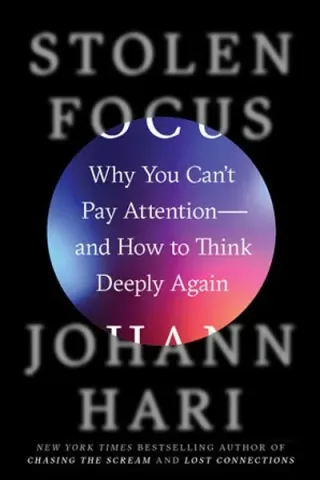
Hook
Your attention span isn’t shrinking because you lack willpower. It’s shrinking because powerful forces are deliberately engineering your distraction — and Johann Hari traveled the world to identify twelve of them.
What It’s About
Stolen Focus argues that the attention crisis isn’t a personal failing but a systemic one. Hari identifies twelve factors that are degrading our collective ability to focus, ranging from the obvious (social media algorithms designed to maximize engagement) to the surprising (rising pollution, declining sleep quality, deteriorating nutrition, and the collapse of sustained reading).
Hari spent three years interviewing experts in technology, neuroscience, psychology, and public health. He visits Silicon Valley engineers who won’t let their own children use the products they build, talks to researchers studying the cognitive effects of pollution, and examines how the shift from reading books to scrolling feeds has altered not just what we think about but how we think.
The book’s most provocative argument is that individual solutions — digital detoxes, focus apps, willpower training — are inadequate because the forces stealing our attention operate at the systemic level. Hari calls for collective solutions: regulating surveillance capitalism, banning manipulative design patterns, redesigning schools and workplaces, and treating attention as a public good rather than a resource to be exploited.
Key Takeaways
Hari’s distinction between individual and systemic causes of distraction is the book’s most important contribution. He argues that telling people to put their phones down while leaving the business model of attention-harvesting intact is like telling people to exercise while flooding their environment with junk food. The system needs to change, not just individual behavior.
The research on “flow states” — deep absorption in a challenging task — is also valuable. Hari shows that flow is the opposite of distraction, and that achieving it requires sustained, uninterrupted time on a single task. He presents evidence that the fragmentation of modern work into constant context-switching makes flow increasingly rare, with devastating consequences for creativity, learning, and satisfaction.
The Verdict
Stolen Focus is an important book that locates the attention crisis where it belongs — in systems and structures, not in individual weakness. Some claims are overstated, and Hari’s journalistic approach sometimes favors narrative over rigor. But the central argument is compelling and the breadth of causes he identifies goes well beyond the usual “put your phone down” advice.