Hook
You’re terrible at predicting what will make you happy. Daniel Gilbert, a Harvard psychologist, explains exactly why — and the answer reveals fundamental flaws in the brain’s simulation software.
What It’s About
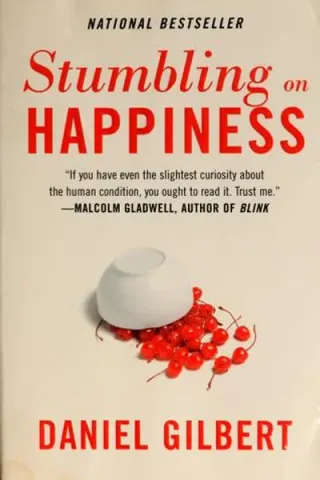
Stumbling on Happiness is not a self-help book about how to be happy — it’s a psychology book about why we’re so bad at predicting what will make us happy. Gilbert argues that the human brain’s ability to simulate future experiences is riddled with systematic errors that lead us to make choices that don’t deliver the happiness we expect.
Gilbert identifies three main problems. First, our imaginations are incomplete — when we imagine a future event, we fill in details based on our current state and leave out crucial context. Second, we project our current feelings onto the future, imagining that we’ll feel the same way about things then as we do now. Third, we dramatically overestimate the emotional impact of both good and bad events — what Gilbert calls “impact bias.” We think winning the lottery will make us blissful forever and losing a limb will make us miserable forever; in reality, we adapt to both far faster than we expect.
The writing is witty, conversational, and packed with clever experiments and analogies. Gilbert has a comedian’s timing and a scientist’s rigor, which makes the book genuinely entertaining. It’s more interested in explaining the phenomenon than solving it, which may frustrate readers looking for actionable advice, but the insights into how the mind works are fascinating.
Key Takeaways
The “impact bias” — our tendency to overestimate the duration and intensity of future emotional reactions — is Gilbert’s most practically useful finding. Understanding that you’ll adapt to almost anything faster than you think can liberate you from both excessive fear and excessive desire. That promotion won’t make you as happy as you think, and that rejection won’t devastate you as long as you fear.
Gilbert’s most surprising recommendation is to ask other people who’ve already experienced what you’re considering how they feel about it, rather than imagining how you’d feel. We resist this advice because we believe we’re unique, but research shows that other people’s reported experiences are far better predictors of our happiness than our own imaginations.
The Verdict
Stumbling on Happiness is one of the most entertaining and insightful books in the happiness literature. It won’t tell you how to be happy, but it will explain why your instincts about happiness are systematically unreliable — which is arguably more useful. Read it for the science and the laughs.