Hook
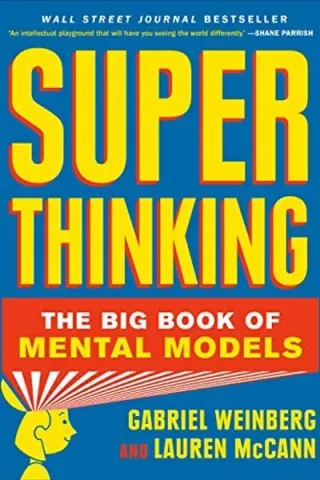
The world’s best thinkers don’t have higher IQs — they have better mental models. Gabriel Weinberg (CEO of DuckDuckGo) curates the most useful mental models from every discipline into one reference guide.
What It’s About
Super Thinking is a comprehensive catalog of mental models organized by theme: being wrong (survivorship bias, confirmation bias), making decisions (cost-benefit analysis, decision trees), modeling and framing problems (Occam’s razor, first principles thinking), physics and math concepts applied to life (critical mass, tipping points, compound growth), and strategic thinking (game theory, competitive advantage).
Weinberg and McCann cover over 300 mental models across nine chapters, with clear explanations and practical examples for each. The book functions as a reference manual — you probably won’t read it cover to cover, but you’ll return to it regularly when facing specific types of problems. Each model gets a concise definition, a concrete example, and suggestions for when to apply it.
The authors draw from economics, physics, biology, psychology, computer science, and philosophy, making the case that the most effective thinkers are those who can pull frameworks from multiple disciplines. The writing is clear if occasionally dry, and the density of the content means some models get only a paragraph or two. But as a curated overview of the thinking tools available to you, it’s remarkably comprehensive.
Key Takeaways
The concept of “inverse thinking” — solving problems by considering what you want to avoid rather than what you want to achieve — is one of the most broadly useful models in the book. Charlie Munger’s famous advice to “invert, always invert” means that instead of asking “how do I succeed?” you ask “what would guarantee failure?” and then avoid those things. This often produces clearer, more actionable insights.
The book’s treatment of second-order thinking — considering not just the immediate consequences of a decision but the consequences of those consequences — is also valuable. Most bad decisions are bad not because of their first-order effects but because of their second- and third-order effects, which are harder to anticipate but often more consequential.
The Verdict
Super Thinking is the most comprehensive mental models reference available. It sacrifices depth for breadth, which makes it better as a reference book than a narrative read. If you want to build a broad toolkit of thinking frameworks, this is an excellent place to start. Just don’t expect the depth you’d get from books dedicated to individual models.