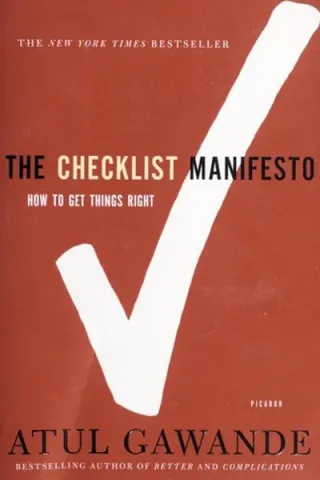
Hook
A surgeon discovers that the humble checklist — the same tool pilots use before takeoff — can save more lives in operating rooms than any breakthrough technology. The implications extend far beyond medicine.
What It’s About
The Checklist Manifesto makes a simple but powerful argument: in an age of increasing complexity, even highly trained professionals make avoidable mistakes because they skip steps, forget details, or fail to communicate. The solution is unglamorous but remarkably effective — the checklist.
Atul Gawande, a surgeon and public health researcher, traces the history of checklists from aviation (where pre-flight checklists transformed safety after a prototype bomber crashed because pilots couldn’t remember all the steps) to construction (where complex building projects coordinate thousands of tasks through systematic checklists) to medicine (where a surgical safety checklist developed by Gawande’s WHO team reduced complications and deaths by over 30%).
The book explores why checklists work: they protect against the failures of memory and attention, make minimum expected standards explicit, and foster teamwork and communication. Gawande also examines why professionals resist them — checklists feel like an insult to expertise, reducing skilled work to rote procedure. He argues persuasively that this resistance is misguided: checklists don’t replace expertise, they free experts to focus on the hard parts by ensuring the routine parts don’t get missed.
Key Takeaways
Gawande’s distinction between “errors of ignorance” (we don’t know enough) and “errors of ineptitude” (we know enough but fail to apply it) is the book’s foundational insight. In many fields, including medicine, the bigger problem is no longer ignorance but ineptitude — we have the knowledge, but the complexity of modern work means we routinely fail to use it properly. Checklists address ineptitude directly.
The design principles for effective checklists are also valuable: keep them short (5-9 items), focus on the most critical “killer items” that are easy to miss, use clear and precise language, and test them in the real world. Bad checklists try to spell out everything; good checklists catch the specific things that experience shows are most likely to be overlooked.
The Verdict
The Checklist Manifesto is a compelling argument for a deceptively simple tool. It’s well-written and well-reported, though it could be tighter — the point is made convincingly within the first hundred pages, and the rest is reinforcement. But the core insight is genuinely important: in complex work, discipline is more valuable than heroism.