Hook
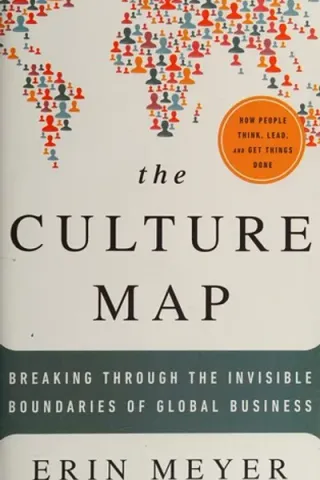
That brilliant idea you presented in Tokyo? They hated it — they just didn’t tell you. Your Dutch colleague’s brutally direct feedback? It’s not rude — it’s respectful. Erin Meyer maps the invisible cultural dimensions that cause international business to go spectacularly wrong.
What It’s About
The Culture Map provides a framework for understanding how cultural differences affect business interactions along eight dimensions: communicating (low-context vs. high-context), evaluating (direct negative feedback vs. indirect), persuading (principles-first vs. applications-first), leading (egalitarian vs. hierarchical), deciding (consensual vs. top-down), trusting (task-based vs. relationship-based), disagreeing (confrontational vs. avoidant), and scheduling (linear-time vs. flexible-time).
Meyer, a professor at INSEAD, positions cultures along each dimension relative to each other — which is crucial, because culture is always relative. Americans are direct communicators compared to Japanese but indirect compared to Dutch. French leadership is hierarchical compared to Scandinavian but egalitarian compared to Chinese. This relative positioning prevents the common mistake of seeing any single culture as “the norm.”
Each chapter combines research, frameworks, and vivid anecdotes from Meyer’s experience advising multinational teams. She explains why a German manager’s direct critique devastates an American employee, why an Indian team says “yes” when they mean “we have concerns,” and why consensus-building in Japan looks nothing like consensus-building in Sweden. The writing is engaging and practical, with actionable advice for adapting your communication style to different cultural contexts.
Key Takeaways
The distinction between “peach” and “coconut” cultures illuminates a common source of friction. In peach cultures (like the US), people are friendly and open on the surface but have a hard core of privacy. In coconut cultures (like Russia and Germany), people are initially formal and reserved but build deep, lasting relationships once trust is established. Each type often misjudges the other — peaches seem fake, coconuts seem cold.
Meyer’s insight that communication and evaluation cultures don’t always align is particularly useful. Americans are low-context communicators (they say what they mean) but wrap negative feedback in positivity. The French are high-context communicators but deliver negative feedback with startling directness. Understanding that a culture’s communication style and its feedback style can diverge prevents costly misreadings.
The Verdict
The Culture Map is essential reading for anyone who works across cultures — which, in today’s business environment, is nearly everyone. The framework is elegant, the examples are memorable, and the practical advice can prevent real damage to business relationships. One of the most useful business books of the last decade.