Hook
What if most of the suffering in your life comes from agreements you made with yourself as a child — agreements you never consciously chose? Don Miguel Ruiz argues that four deceptively simple principles can dismantle decades of self-limiting beliefs.
What It’s About
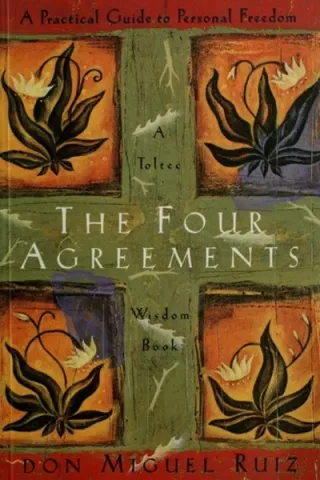
The Four Agreements draws on ancient Toltec wisdom to present a code of conduct that Ruiz claims can transform your life. The premise is straightforward: from the moment we’re born, society “domesticates” us — parents, teachers, religion, and culture impose beliefs and rules that we internalize without question. These unconscious agreements shape how we see ourselves and the world, and most of them cause needless suffering.
Ruiz’s antidote is four new agreements. First, be impeccable with your word — speak with integrity, say only what you mean, and avoid using words against yourself or others. Second, don’t take anything personally — what others say and do is a projection of their own reality, not yours. Third, don’t make assumptions — find the courage to ask questions and communicate clearly. Fourth, always do your best — which varies from moment to moment, but frees you from self-judgment.
The book is short, almost deceptively so, and reads more like a philosophical meditation than a research-backed self-help manual. Ruiz weaves in Toltec mythology and spiritual metaphors that may resonate with some readers and feel abstract to others. The strength is in the simplicity — these four principles are easy to remember and genuinely useful as daily mental anchors.
Key Takeaways
The most powerful agreement is arguably the second: don’t take anything personally. Ruiz makes a compelling case that most interpersonal conflict stems from our assumption that other people’s behavior is about us. When you truly internalize that everyone is living in their own dream, reacting to their own wounds, criticism loses its sting and you gain remarkable emotional freedom.
The concept of “domestication” is also worth sitting with. Ruiz argues that we punish ourselves repeatedly for the same mistakes because we absorbed a punitive belief system as children. Breaking free requires awareness first — recognizing the agreements you never chose — and then deliberately replacing them. It’s not instant, but the framework gives you a clear starting point.
The Verdict
The Four Agreements is a quick, thought-provoking read that offers genuinely useful mental models. It lacks the scientific rigor of modern psychology books, and the spiritual framing won’t appeal to everyone. But the core ideas are timeless and practical enough to earn a spot on the shelf.