Hook
Perfectionism isn’t about striving for excellence — it’s a shield against vulnerability and shame. Brene Brown’s research reveals that letting go of who you think you’re supposed to be is the key to embracing who you actually are.
What It’s About
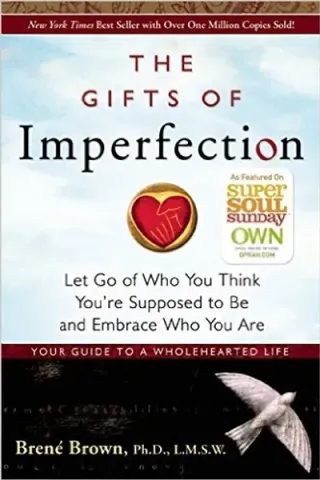
The Gifts of Imperfection is Brene Brown’s guide to “wholehearted living” — her term for engaging with the world from a place of worthiness rather than a place of scarcity. Based on years of qualitative research into shame, vulnerability, and authenticity, Brown identifies ten “guideposts” for cultivating a wholehearted life.
The guideposts include: cultivating authenticity (letting go of what people think), self-compassion (letting go of perfectionism), resilience (letting go of numbing and powerlessness), gratitude and joy (letting go of scarcity and fear of the dark), intuition and faith (letting go of the need for certainty), creativity (letting go of comparison), play and rest (letting go of exhaustion as a status symbol), calm and stillness (letting go of anxiety), and meaningful work (letting go of self-doubt).
Brown writes with characteristic warmth and vulnerability, sharing her own struggles with each guidepost. The book is shorter and more personal than Daring Greatly, functioning more as a meditation on self-acceptance than a research treatise. Each chapter combines research findings with personal stories and practical suggestions, making the concepts feel both academically grounded and emotionally accessible.
Key Takeaways
Brown’s research finding that joy and gratitude are inextricably linked is one of the book’s most important insights. People who describe themselves as joyful all share one characteristic: they practice active gratitude. Joy isn’t a precondition for gratitude — gratitude is a precondition for joy. This flips the common assumption and provides a practical entry point for anyone seeking more joy.
The reframe of perfectionism as a form of self-protection rather than self-improvement is equally powerful. Brown shows that perfectionism is driven by the belief “If I do everything perfectly, I can avoid shame and judgment.” This makes perfectionism not a path to excellence but a strategy for hiding — and it’s a strategy that inevitably fails because no one can be perfect.
The Verdict
The Gifts of Imperfection is Brown at her most personal and accessible. It’s a shorter, gentler book than Daring Greatly — less research-heavy and more reflective. If you’re new to Brown’s work, this is an excellent starting point. If you’ve read Daring Greatly, this covers similar territory with a more intimate lens.