Hook
Gretchen Rubin wasn’t unhappy — she just wasn’t as happy as she could be. So she spent a year systematically testing every happiness strategy she could find, one month at a time. The results are more nuanced than you’d expect.
What It’s About
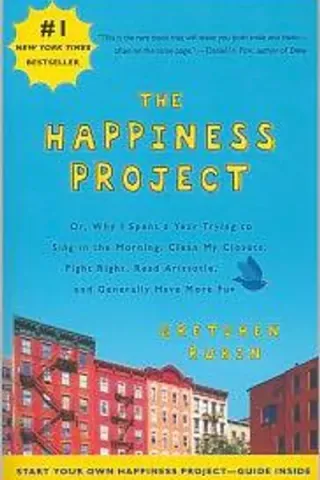
The Happiness Project chronicles Rubin’s yearlong experiment in boosting her own happiness through deliberate, research-informed strategies. Each month she focuses on a different area: vitality (January), marriage (February), work (March), parenthood (April), leisure (May), friendship (June), money (July), eternity (August), books (September), mindfulness (October), attitude (November), and a combined month of everything (December).
Rubin draws on positive psychology research, philosophy, and memoir to design monthly resolutions — specific, actionable behaviors like “don’t gossip,” “sing in the morning,” “give proofs of love,” and “buy some happiness.” She tracks her adherence and reports honestly on what works, what doesn’t, and what surprises her. The writing is conversational and self-aware, and Rubin is refreshingly honest about her own neuroses and contradictions.
The book’s strength is its specificity — Rubin doesn’t just say “be grateful” or “exercise more,” she describes exactly what she did, how it felt, and what happened. Its limitation is that Rubin’s life circumstances (she’s an affluent writer in Manhattan) make some strategies feel inaccessible, and the format can feel like an extended blog post — which it partly is, having grown from her popular blog.
Key Takeaways
Rubin’s first commandment — “Be Gretchen” — captures the book’s most important insight: happiness strategies must fit your actual personality, not some idealized version of yourself. She discovers that some universally recommended happiness practices (like meditation) don’t work for her, while others (like clearing clutter) produce outsized benefits. The lesson is to experiment with happiness strategies rather than adopting them wholesale from experts.
Her observation that outer order contributes to inner calm is simple but practical. Rubin finds that seemingly trivial actions — making the bed, organizing a drawer, clearing a shelf — produce disproportionate improvements in mood and mental clarity. This aligns with research on decision fatigue and the psychological impact of environmental disorder.
The Verdict
The Happiness Project is an honest, relatable account of one person’s systematic pursuit of greater happiness. It lacks the scientific depth of books like Stumbling on Happiness or The How of Happiness, and the personal narrative won’t resonate with everyone. But Rubin’s experimental approach and practical specificity make it a useful template for designing your own happiness project.