Hook
Great companies don’t fail because they’re badly managed. They fail because they’re well managed — they listen to their best customers, invest in the most profitable products, and follow all the rules of good management right off a cliff.
What It’s About
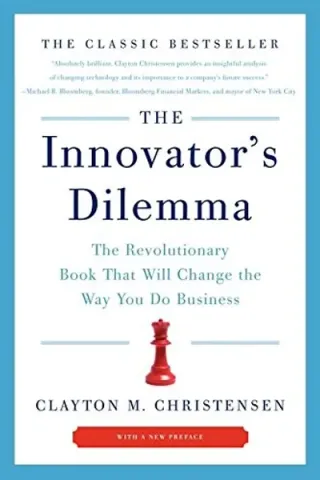
The Innovator’s Dilemma explains why successful companies lose their market leadership when confronted with disruptive technologies. Clayton Christensen, a Harvard Business School professor, studied industries from disk drives to steel mills to excavators and found a consistent pattern: incumbent companies, doing everything right by the standards of good management, were repeatedly blindsided by inferior products from below.
The mechanism is elegant and devastating. Disruptive innovations start as inferior products that appeal to low-end or new-market customers that incumbents don’t care about. Because these innovations are initially less profitable, serving smaller or less demanding customers, rational resource allocation pushes incumbents to focus on sustaining innovations for their best customers instead. By the time the disruptive technology improves enough to compete in the mainstream market, the incumbents have lost their position.
Christensen distinguishes between sustaining innovations (improvements to existing products for existing customers) and disruptive innovations (initially inferior products that create new markets or serve overlooked customers). The key insight is that the very management practices that lead to success with sustaining innovations — listening to customers, investing in profitable technologies, pursuing large markets — are precisely the practices that cause failure when facing disruption.
Key Takeaways
The concept of “disruptive innovation” has become so widely used that it’s often misapplied, but Christensen’s original definition is precise and useful. True disruption comes from below — not from better products that compete head-to-head, but from simpler, cheaper, or more convenient alternatives that initially serve customers the incumbent has ignored.
Christensen’s prescription for incumbents — creating autonomous units separated from the parent organization to pursue disruptive opportunities — addresses the structural problem directly. The main organization’s incentives, processes, and values are designed for sustaining innovation; only a separate entity with different metrics and customers can pursue disruption without being killed by the parent’s immune system.
The Verdict
The Innovator’s Dilemma is one of the most important business books of the last thirty years. Its framework has been validated repeatedly across industries, and its insights into why good management can lead to failure are genuinely counterintuitive. Some later applications of the theory have been overstretched, but the original book remains essential reading for anyone in business strategy.