Hook
Written in 1959 and still selling strong, David Schwartz argues that the size of your success is determined by the size of your belief — and that thinking big is a learnable skill, not an innate trait.
What It’s About
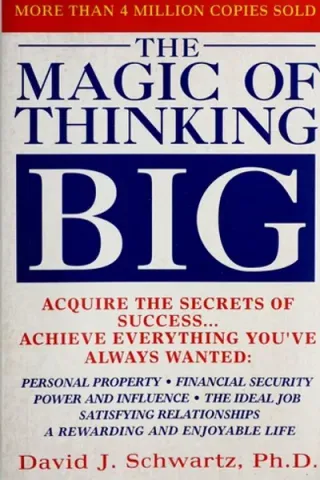
The Magic of Thinking Big is a classic self-help book built on a single premise: people who achieve great things think differently from those who don’t, and those thinking patterns can be learned and practiced. Schwartz, a professor of marketing, draws on his observations of successful professionals to identify the mental habits that separate high achievers from everyone else.
The book covers belief (you have to believe you can succeed before any technique will work), excusitis (the habit of making excuses about health, intelligence, age, or luck), fear management (action cures fear, inaction feeds it), creative thinking (believing something can be done is the first step to figuring out how), and the importance of environment (you become like the people you associate with).
Schwartz writes in a warm, encouraging style with an abundance of examples — some from prominent figures, most from ordinary professionals who applied “big thinking” to their careers and lives. The advice is predominantly attitudinal rather than tactical: think big, act big, expect big results. The book predates modern positive psychology research but anticipates many of its findings about growth mindset, self-efficacy, and the relationship between expectation and performance.
Key Takeaways
Schwartz’s concept of “excusitis” — the chronic habit of explaining away failure with external factors — is a useful diagnostic tool. He identifies four common varieties: health excusitis, intelligence excusitis, age excusitis, and luck excusitis. In each case, he provides examples of people who succeeded despite having far worse versions of the excuse you’re using, which is both motivating and slightly guilt-inducing.
The chapter on fear management offers practical advice that holds up well. Schwartz argues that the only cure for fear is action — hesitation and overthinking amplify anxiety, while doing the thing you fear, even imperfectly, reduces it. This aligns with exposure therapy research in clinical psychology and with more recent work on courage as a habit.
The Verdict
The Magic of Thinking Big is a solid, if somewhat dated, motivational book. The core message about the power of belief and ambition is well-supported by modern psychology, even if Schwartz didn’t have the research to cite. Some examples feel antiquated, and the relentless positivity can feel simplistic. But as a primer on thinking bigger about your potential, it does exactly what the title promises.