Hook
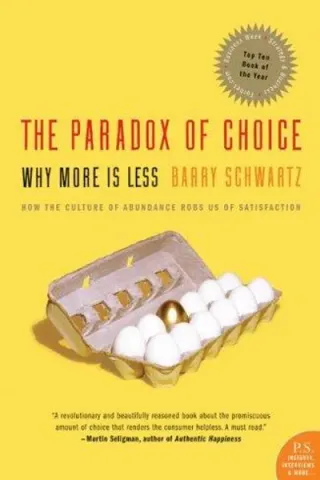
More choice should make us happier. It doesn’t. Barry Schwartz explains why the explosion of options in modern life is making us more anxious, more indecisive, and less satisfied with the choices we do make.
What It’s About
The Paradox of Choice argues that while some choice is better than none, more choice is not always better than less. Schwartz, a psychologist at Swarthmore College, presents research showing that as the number of options increases, the effort required to make a decision increases, the anxiety about making the wrong choice increases, and the satisfaction with the chosen option decreases.
Schwartz covers the psychology behind this paradox: escalation of expectations (with so many options, we expect the perfect choice to exist), opportunity cost (every choice means giving up alternatives, and the more alternatives, the greater the regret), self-blame (with so many options, a bad outcome feels like your fault for choosing wrong), and adaptation (even good choices become less satisfying over time as we adapt).
He distinguishes between “maximizers” (people who must examine every option to ensure they’ve chosen the best) and “satisficers” (people who choose the first option that meets their criteria). Research shows that satisficers are consistently happier, less stressed, and more satisfied with their decisions — even though maximizers often make objectively better choices. The book offers practical strategies for becoming more of a satisficer in a world designed to make you maximize.
Key Takeaways
The maximizer/satisficer distinction is the book’s most practically useful framework. Understanding which category you fall into — and in which domains — allows you to deliberately choose “good enough” in low-stakes decisions, freeing mental energy for the choices that actually matter. You don’t need to optimize your choice of toothpaste.
Schwartz’s recommendation to “choose when to choose” — deliberately limiting the number of options you consider and decisions you make each day — anticipates the later popularity of decision fatigue research and Steve Jobs’s famous uniform. The fewer trivial decisions you make, the better your important decisions become.
The Verdict
The Paradox of Choice is a compelling argument with immediate practical implications. The book could be shorter — the point is well-made by chapter five but continues for ten more — and some of the research has been questioned in replication attempts. But the core insight that more options can decrease happiness is well-supported and genuinely useful for navigating modern life.