Hook
Your mind is not you — and the voice in your head that never shuts up is the source of most of your suffering. Eckhart Tolle wants to show you the off switch.
What It’s About
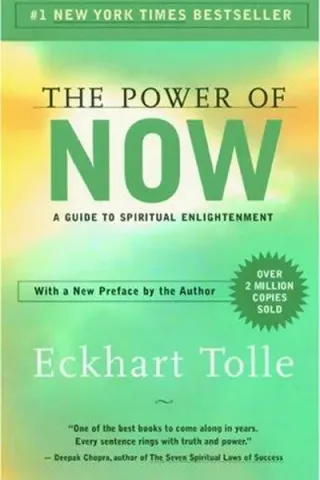
The Power of Now is a spiritual guide to living fully in the present moment. Tolle’s core argument is that the human mind, left to its own devices, is a dysfunction machine — constantly replaying the past, worrying about the future, and generating an endless stream of thoughts that most people mistake for their identity. True peace, he says, comes from disidentifying with the mind and anchoring yourself in present-moment awareness.
The book is structured as a Q&A dialogue, with Tolle answering questions that progress from basic concepts to deeper spiritual territory. He introduces the idea of the “pain-body” — accumulated emotional pain that feeds on negative thinking — and offers techniques for observing your thoughts without getting swept away by them.
Tolle draws from Buddhism, Hinduism, Christianity, and other traditions without aligning with any single religion. The writing oscillates between profound clarity and vague mysticism. When he’s concrete, the insights are genuinely transformative. When he veers into abstract territory, some readers will find it frustrating.
Key Takeaways
The most actionable insight is the distinction between “clock time” and “psychological time.” Clock time is practical — you use it to schedule meetings and plan projects. Psychological time is when you mentally live in the past or future, generating anxiety and regret. Tolle argues that nearly all suffering comes from psychological time, and the cure is simply to notice when you’ve slipped into it.
The concept of observing your thoughts — becoming the “watcher” — is borrowed from meditation traditions but presented accessibly here. Creating even a small gap between you and your mental chatter can produce dramatic improvements in peace and decision-making.
The Verdict
The Power of Now contains genuinely life-changing ideas wrapped in occasionally impenetrable spiritual language. If you can tolerate the mystical framing, the practical core is as useful as any mindfulness book ever written. Skim the abstract passages, linger on the concrete ones.