Hook
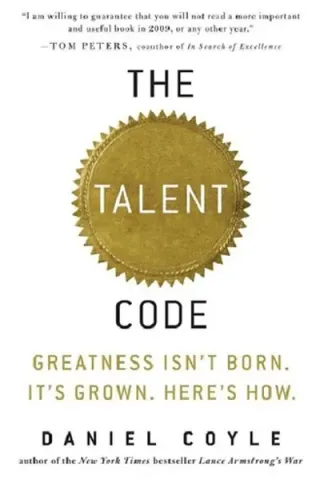
Talent isn’t born — it’s grown. And the mechanism is a neural insulator called myelin that wraps around nerve fibers every time you practice something at the edge of your ability. Daniel Coyle traveled to the world’s greatest talent hotbeds to figure out how.
What It’s About
The Talent Code investigates why certain places — a tennis club in Moscow, a music school in Dallas, a soccer field in Brazil — produce a disproportionate number of world-class performers. Coyle’s answer centers on three elements: deep practice, ignition, and master coaching.
Deep practice is the most scientifically grounded element. Coyle explains that when you practice at the edge of your ability — making mistakes, correcting them, and gradually expanding your capabilities — your brain wraps nerve fibers in myelin, a fatty insulator that makes neural circuits faster and more accurate. This biological mechanism explains why targeted, effortful practice produces skill development while mindless repetition doesn’t.
“Ignition” is the motivational spark — the moment that makes someone decide to commit to deep practice. Coyle finds that ignition often comes from identity rather than passion: seeing someone who looks like you achieve something extraordinary creates a deep belief that “I could do that too.” Master coaching, the third element, involves teachers who can break complex skills into small chunks, provide immediate feedback, and keep students in the sweet spot between boredom and frustration.
Key Takeaways
The myelin model provides a biological explanation for deliberate practice that makes the concept more tangible and motivating. Knowing that every quality repetition literally builds your brain’s wiring transforms practice from drudgery into construction. You’re not just “putting in hours” — you’re building neural architecture.
Coyle’s research on talent hotbeds also debunks genetic determinism. The best violinists in the world don’t come from places with better genes — they come from places with better practice cultures, more inspiring role models, and coaches who know how to structure skill development. This is both empowering (talent is buildable) and demanding (it requires sustained, focused effort).
The Verdict
The Talent Code is an engaging, well-reported book that makes the science of skill acquisition accessible. It covers similar ground as Peak by Anders Ericsson and Range by David Epstein, but the myelin angle gives it a distinctive hook. If you’re a coach, teacher, parent, or anyone interested in developing skills, it’s a worthwhile read.