Hook
The world doesn’t work in straight lines — it works in loops, delays, and feedback cycles. Donella Meadows provides the clearest introduction ever written to the discipline that explains why good intentions produce bad outcomes and why problems keep coming back.
What It’s About
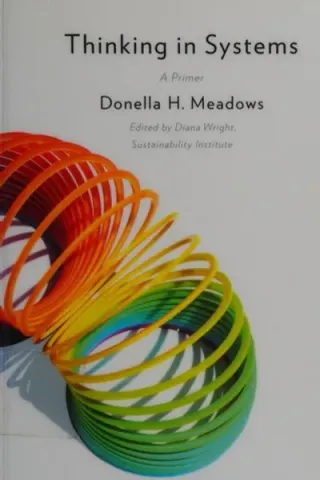
Thinking in Systems is a primer on systems thinking — the discipline of understanding how complex systems behave over time. Meadows, an environmental scientist and lead author of The Limits to Growth, introduces the building blocks of systems: stocks (accumulations), flows (rates of change), feedback loops (reinforcing and balancing), and delays (time lags between cause and effect).
With these simple elements, Meadows explains phenomena that otherwise seem mysterious: why drug enforcement increases drug profits and violence, why fishing quotas can accelerate stock depletion, why corporate cost-cutting often increases costs, and why the rich get richer. Each example demonstrates how the structure of a system — its feedback loops, delays, and information flows — determines its behavior far more than the individuals within it.
The book progresses from simple systems to complex ones, introducing concepts like resilience (a system’s ability to absorb disturbance), self-organization (a system’s ability to learn and evolve), and hierarchy (how complex systems are built from subsystems). Meadows writes with remarkable clarity and humanity, making abstract concepts tangible through everyday examples and genuine wonder at the complexity of the world.
Key Takeaways
The most powerful insight is that the behavior you observe in any system is usually a product of its structure, not the intentions or competence of the people within it. Blaming individuals for systemic outcomes is both unfair and ineffective — you have to change the system to change the behavior. This applies to organizations, markets, ecosystems, and personal habits.
Meadows’s hierarchy of “leverage points” — places within a system where a small change can produce large effects — is one of the most useful frameworks in the book. The most powerful leverage points are not the ones most people focus on (changing numbers, adjusting flows) but deeper structural interventions: changing the rules of the system, the goals of the system, and ultimately the paradigm that created the system.
The Verdict
Thinking in Systems is one of those rare books that genuinely changes how you see the world. It’s short, clear, and profound — a book you’ll reference for years. Essential reading for leaders, policymakers, designers, and anyone who wants to understand why complex problems resist simple solutions.