Hook
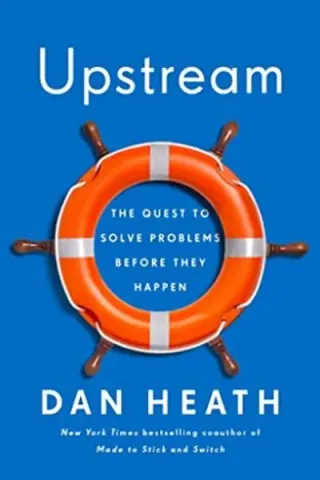
We spend most of our time pulling drowning people out of the river instead of walking upstream to figure out why they’re falling in. Dan Heath argues that this reactive bias is the most expensive mistake organizations and individuals make.
What It’s About
Upstream examines why people and organizations persistently focus on reacting to problems rather than preventing them. Dan Heath (co-author of Switch and Made to Stick) identifies three forces that push us downstream: problem blindness (we don’t see the problem because it seems like the natural state of things), lack of ownership (we assume someone else is responsible), and tunneling (we’re so overwhelmed by immediate crises that we can’t think about prevention).
The book profiles organizations that have successfully shifted upstream: a health system that reduced ER visits by addressing patients’ social needs, a school district that slashed dropout rates by identifying at-risk students years before they would have dropped out, and a city that eliminated homelessness through proactive housing programs. Each case demonstrates that upstream interventions are dramatically more cost-effective than downstream reactions — but harder to implement because the benefits are invisible (problems that didn’t happen can’t be measured).
Heath also addresses the challenges of upstream thinking: how to find the right leverage point, how to measure success when you’re preventing events that would have occurred, how to avoid unintended consequences, and how to maintain funding for programs whose success makes them appear unnecessary.
Key Takeaways
The concept of “problem blindness” — when a problem is so pervasive that we stop seeing it as a problem and start accepting it as normal — is Heath’s most powerful insight. Every industry has issues that insiders have stopped questioning because “that’s just how it works.” The upstream thinker’s first job is to see the familiar with fresh eyes and ask “Does it have to be this way?”
Heath’s framework for designing upstream interventions — identifying leverage points where small investments prevent large downstream costs — is immediately applicable. The key question is: “Where in the system does a small action now prevent a much larger problem later?” This applies to business processes, personal health, relationship maintenance, and organizational design.
The Verdict
Upstream is a practical, well-researched argument for prevention over reaction. It’s not as groundbreaking as the Heath brothers’ earlier work, but the core framework is sound and the examples are compelling. Read it to shift your default from firefighting to fire prevention.