Hook
You’re probably not sleeping enough, and the consequences are far worse than you think. Matthew Walker, a neuroscientist who has spent 20 years studying sleep, makes a terrifying case that sleep deprivation is dismantling your health, your cognitive ability, and your longevity.
What It’s About
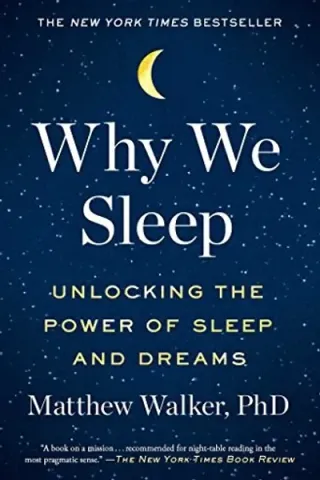
Why We Sleep is a comprehensive overview of sleep science, covering what sleep is, why we need it, how dreams work, and what happens when we don’t get enough. Walker, a professor of neuroscience at UC Berkeley, draws on his own research and the broader field to argue that sleep is the single most important thing you can do for your health — more important than exercise, diet, or any medication.
The book catalogs the damage of insufficient sleep with alarming specificity: impaired immune function, increased cancer risk, cardiovascular disease, weight gain, reduced fertility, impaired memory consolidation, emotional dysregulation, and dramatically increased risk of car accidents. Walker argues that sleeping less than seven hours a night produces measurable cognitive and physical impairment, comparable to being legally drunk.
Walker also covers the mechanisms of sleep — the interplay between circadian rhythms and sleep pressure, the different functions of NREM and REM sleep, and the role of dreams in emotional processing and creativity. He devotes chapters to the societal factors that undermine sleep: screens, caffeine, alcohol, alarm clocks, and work cultures that reward sleeplessness. The writing is clear and the research is fascinating, though some scientists have criticized Walker for overstating certain claims and cherry-picking evidence.
Key Takeaways
The most important takeaway is that sleep is non-negotiable. Walker demolishes the myth that some people can thrive on less sleep — the percentage of people who can function normally on fewer than six hours, determined by a rare genetic mutation, rounds to zero. If you think you’re one of them, you’re almost certainly wrong; you’ve just forgotten what being fully rested feels like.
The role of sleep in memory and learning is also striking. Walker shows that sleep before learning prepares the brain to absorb new information, and sleep after learning consolidates memories and integrates them with existing knowledge. All-nighters don’t just make you tired — they actively prevent you from retaining what you studied.
The Verdict
Why We Sleep is an important book with a crucial message: sleep more, and protect your sleep aggressively. The science is fascinating and the practical implications are clear. Some specific claims have been challenged by other researchers, so read with appropriate skepticism, but the core message — that modern society’s casual relationship with sleep is a public health crisis — is well-supported.